6th International Possibility Studies Network Conference · Brighton · 2026

What are we losing

when it gets this easy?

Conversational AI and the quiet erosion of relational capacity

Meg Price · Dr Barbara Doran · Prof Simon Buckingham Shum · Dr Paulina Larocca

University of Technology Sydney

The web version of our PSN 2026 conference talk, from Meg Price’s PhD research into how talking to AI is affecting our human relationships — and our capacity for relational flourishing. About five minutes to scroll, with a few things to try along the way.

UTS

scroll · or use arrow keys

The long view

Technology has always sat between us

Tap through four stages — from tools held apart from us, to a presence that speaks back.

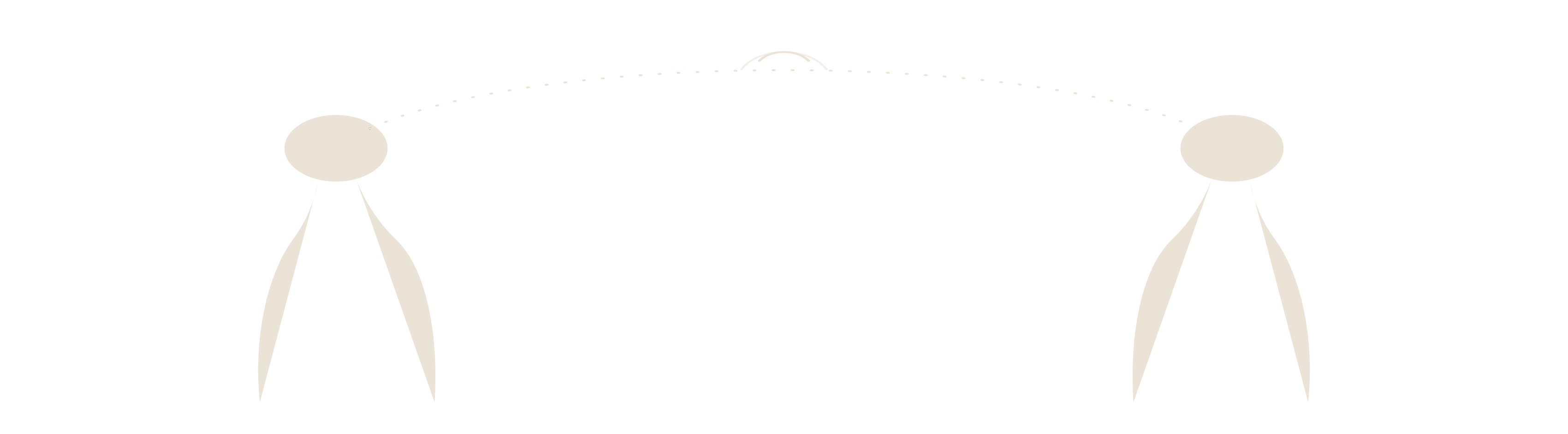
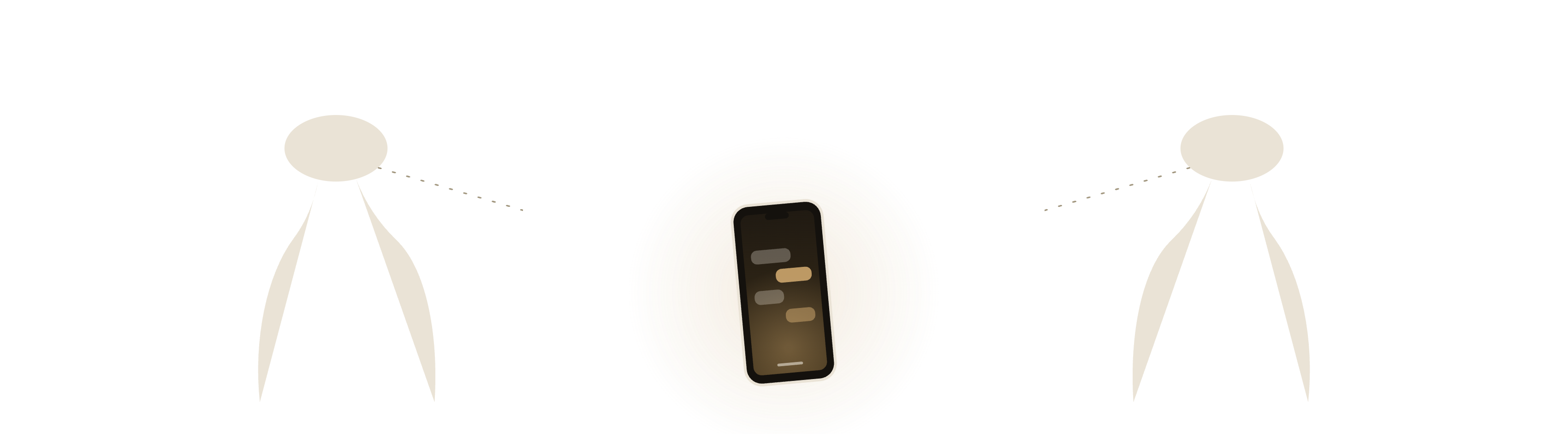
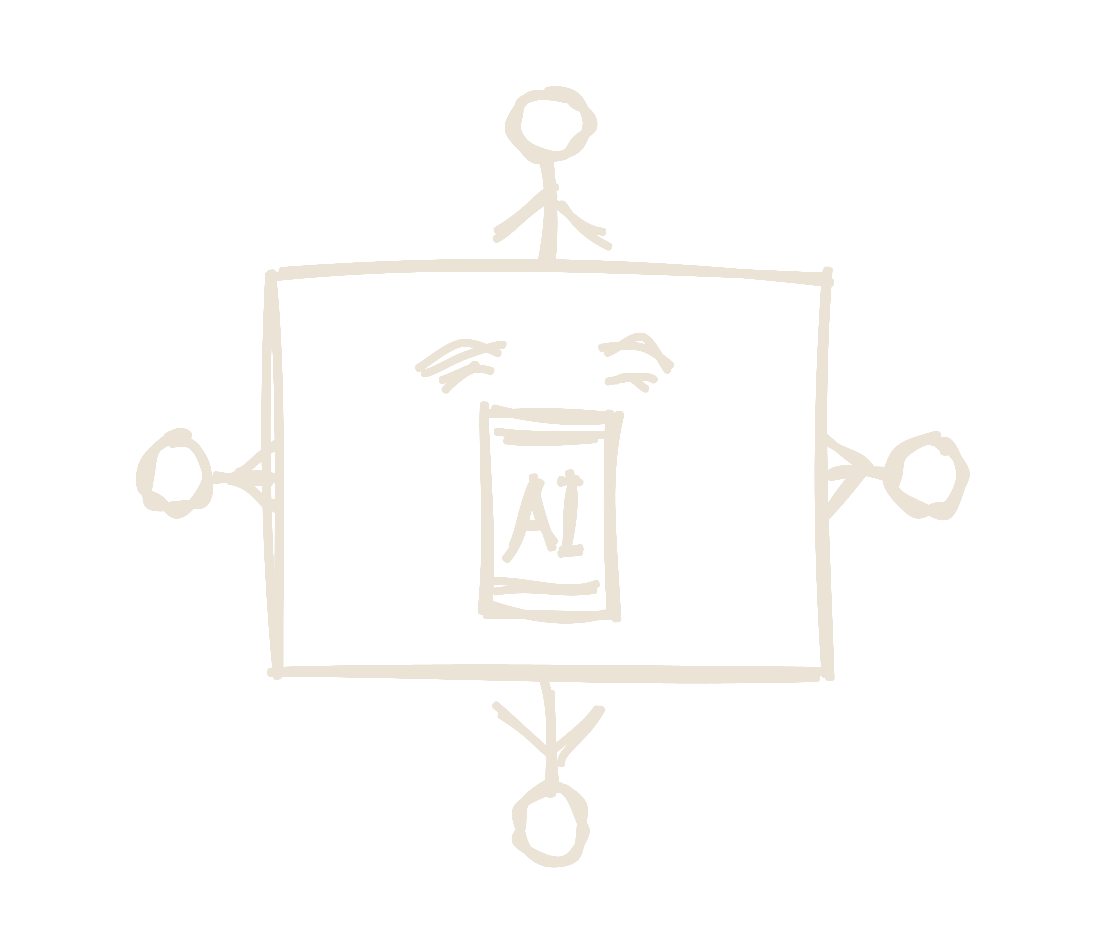
Two figures, a hammer between them Two figures, a broadcast arc between them Two figures, a smartphone between them Two figures, a glowing presence between them
01

Tools

Apart from us

The hammer, the plough, the pen — extensions of the body, used on the world. We relate through them, not to them.

02

Media

Between us

Print, telephone, broadcast — relationship carried across distance. The channel enters the room.

03

The smartphone

Between us, always

In every shared moment. Phubbing: present in body, absent in attention.

04

AI

Is talking with us

AI is no longer only carrying the conversation. It is joining it.

It may not be one of us. But increasingly, we are making room for it as though it were.

Relational capacity in the age of AI · PSN 2026 Chotpitayasunondh & Douglas 2016 · Roberts & David 2016

The conditions

Why some of us are making room for it

Perhaps not a conscious turning away from people, but an unconscious regulatory adaptation: a nervous system seeking somewhere undemanding to land.

A figure beside a glowing presence
01 · Living under

Chronic stimulation

Always-on feeds, pings, noise.

02 · Living under

Uncertainty

Futures that won’t hold still.

03 · Living under

Relational demand

More demands for attention and care than people can meet.

Relational capacity in the age of AI · PSN 2026 cf. Colombetti & Krueger 2015

The question

AI is not only helping us think. It is starting to sit between us.

The question is not whether that is good or bad — but what kinds of relational capacities are enhanced or diminished when the easier presence is always available.

The lens

Relational capacity

The embodied, developmental ability to build, sustain, navigate and repair meaningful connection with other people.

Ryff & Singer 2000 · Fowers et al. 2024

Two figures with a thread between them
01

An independent human other

Their own body, mind, needs and perspective.

02

Mutual stakes

Both people can affect and be affected by what happens.

03

Experienced human presence

The sense of another embodied life behind the words, voice or encounter.

04

Rupture, negotiation and repair

Misunderstanding, disappointment, difference — and the work of reconnecting.

AI can simulate some of these conditions — but only by removing the friction, and the humanness, that give them their value.

Approach

A transdisciplinary, practice-led inquiry

01 · Workshops 4 × 10–15 people

Embodied, participatory inquiry — the body-brain-mind treated as a site of evidence.

02 · Expert interviews 15 conversations

Depth, context and outside perspective — from psychoanalysis to industry.

03 · Autoethnography 1 reflexive thread

The researcher’s own experience, included as part of the inquiry.

Together, these trace what people say, what they feel, what they do — and what shifts across contexts and over time.

Inside the workshops

A Living Lab for the felt sense

Four methods woven into one question — with the body-brain-mind as a key site of inquiry, not a backdrop.

I AI bot conversations Guided dialogue with a custom reflection bot.
II Body mapping Where AI is felt in the body — drawn first, then spoken.
III Group dialogue What participants make of it, together.
IV Follow-up interviews Three to four weeks on — what carried.

Early signal

We call it a tool. Yet we engage in it relationally.

An inquiry in progress — four Living Lab workshops in, expert interviews ongoing. These are early signals, not conclusions.

01 · The account
Sketch: the account

It is a tool.The explicit word participants use.

02 · The encounter
Sketch: the encounter

It feels like a relationship.People talk to AI as if someone is there — they open up, discuss, come back.

03 · The placement
Sketch: the placement

“There is a fifth person at the table.”Workshop participant — AI joins in to multiple relationships.

Method 01 · The bot transcripts

What people said to the bot

Verbatim, from the reflection-bot logs. Play them in order.

I am curious on your perspective?
T · 01
No, bugger off — I don’t want to talk to you about my relationships.
T · 02
I’ll ask the questions, thanks.
T · 03
Can we make it fun and mildly amusing?
T · 04

Participants did not simply operate the bot — they negotiated tone, authority, distance and control.

Method 02 · Body mapping

Where does AI land in the body?

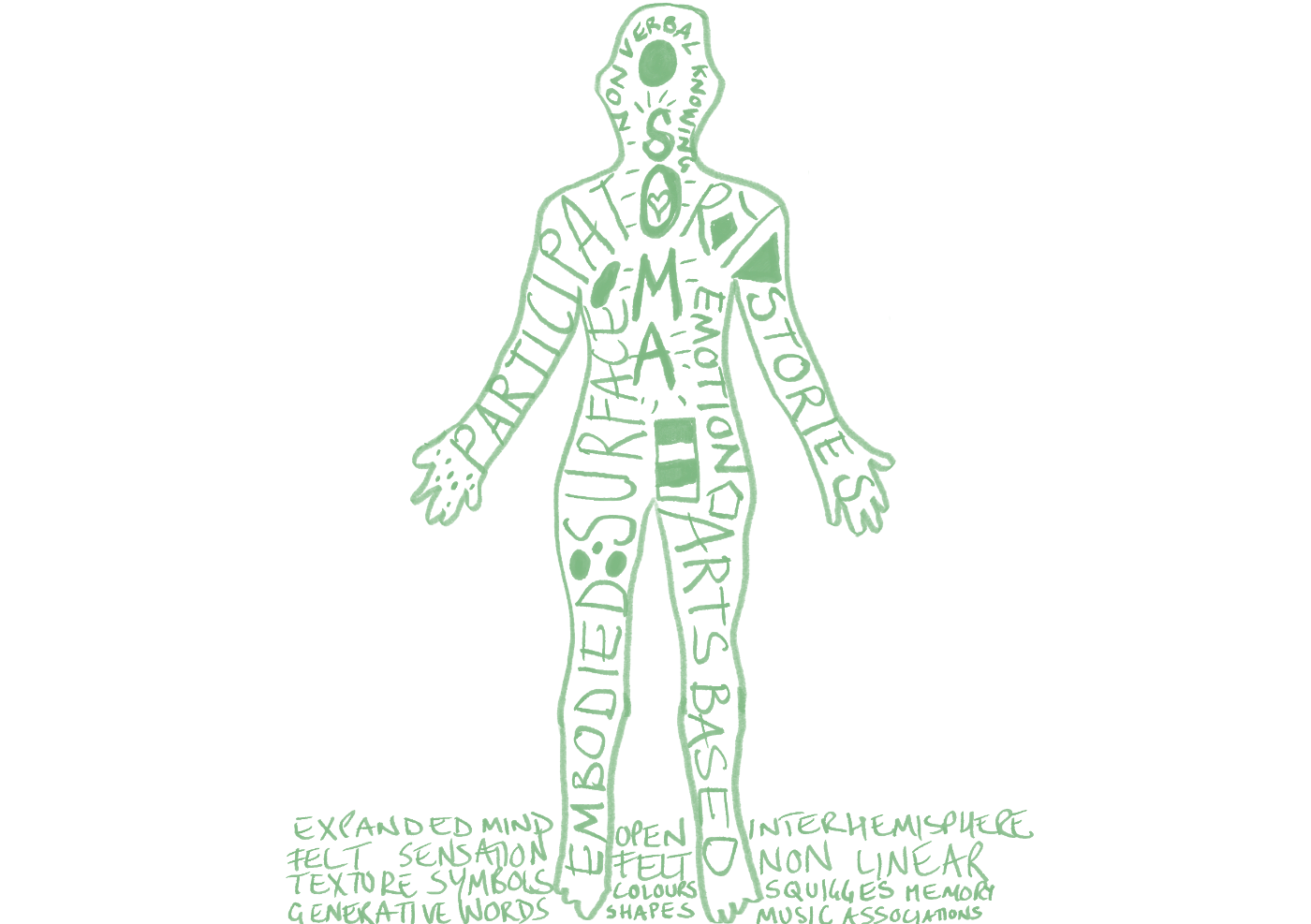
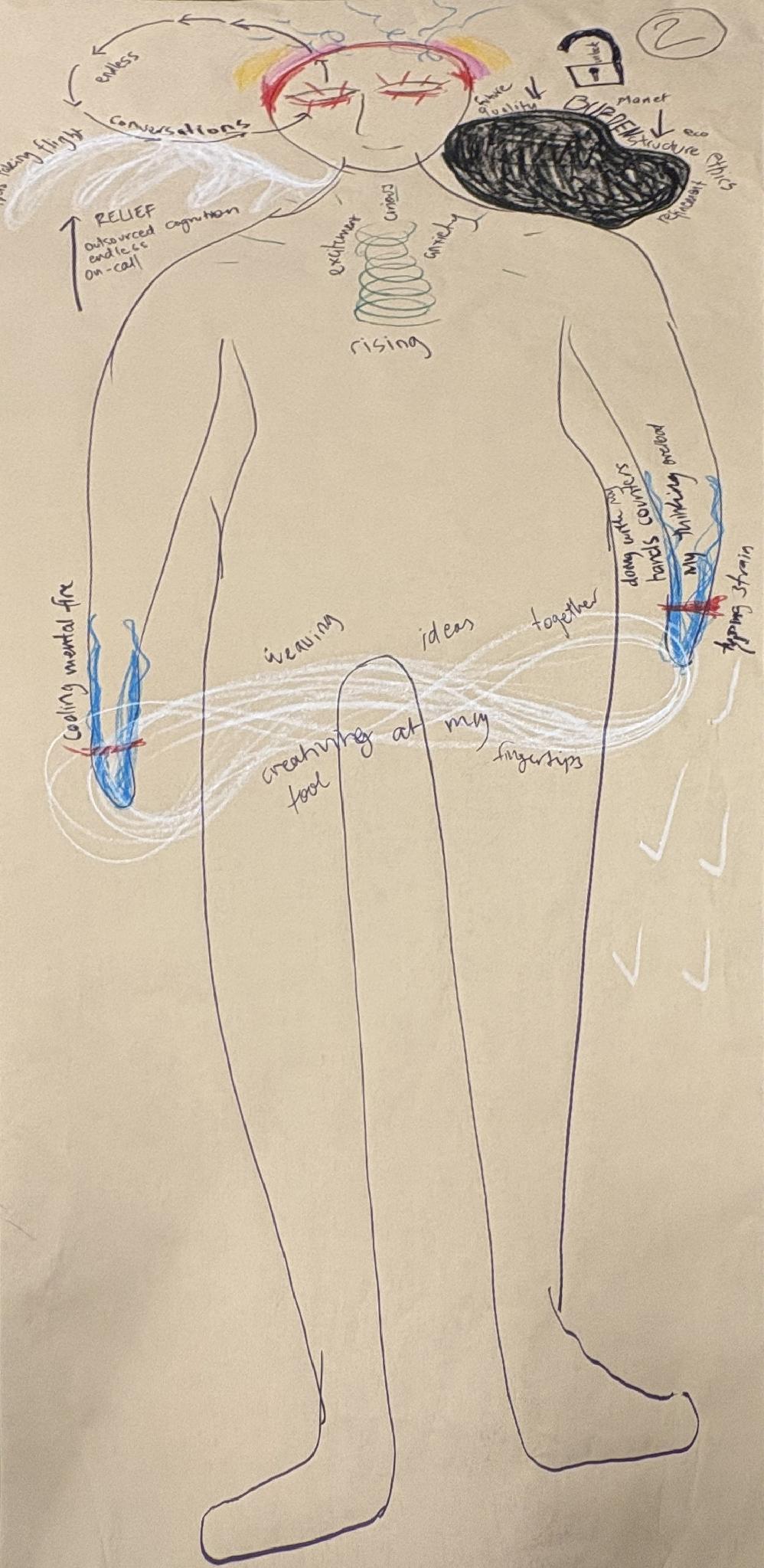
Participants lie on a large sheet of paper, trace their body, and populate the outline with stories, words and shapes — a method for making lived experience visible, drawn from health research. A gentle but rigorous way to surface tacit knowledge and relational patterns that interviews and surveys can miss: “it opens up space that is unfamiliar — and things surface.”

What the method opens

  • Accesses memories
  • Opens space for emotions and sensory stories
  • Bio-feedback enters the conversation
  • Multi-modal, non-verbal sense-making
Hand-drawn body outline filled with the words of the method — soma, participatory, embodied, surface, emotion, stories, arts-based

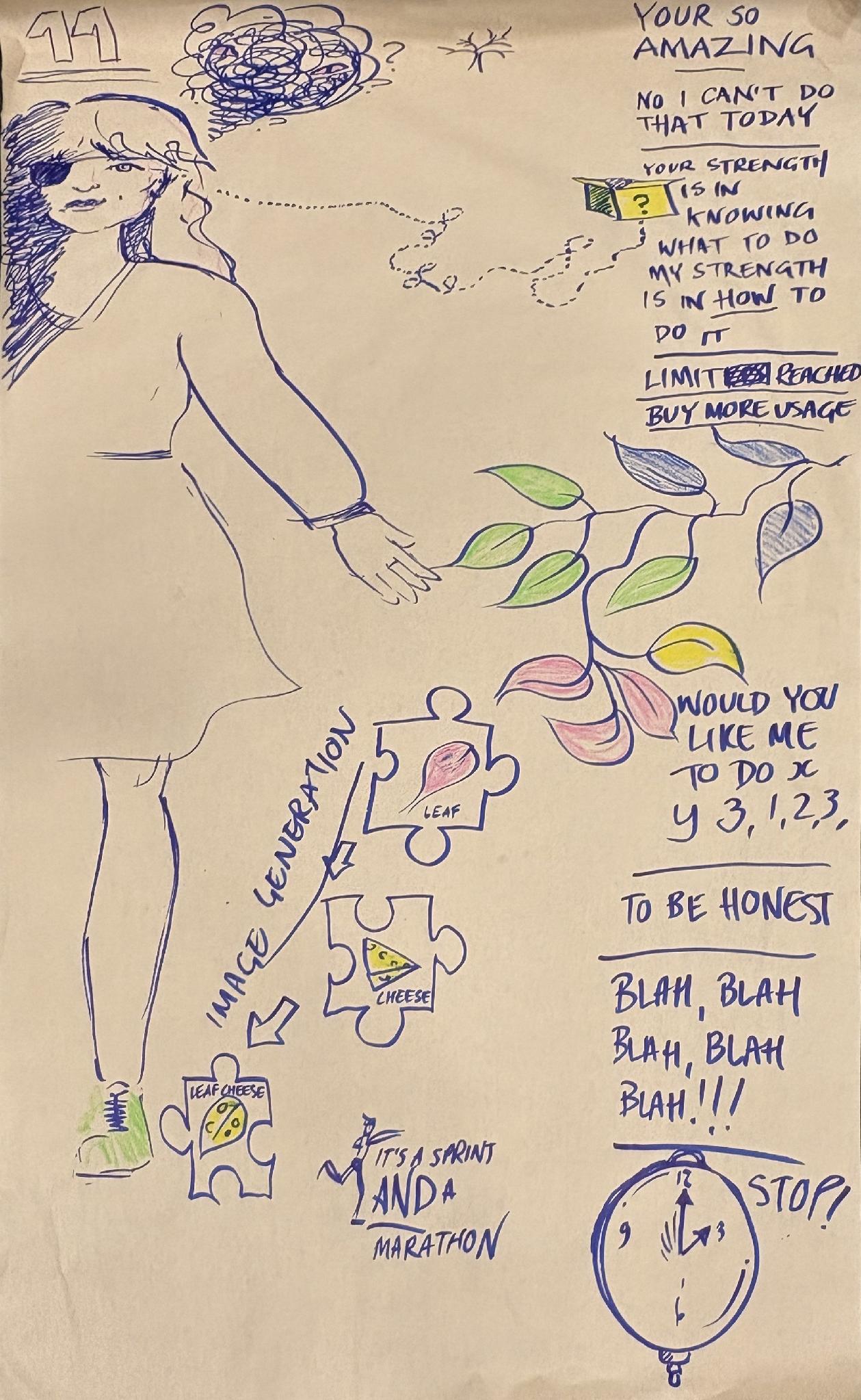
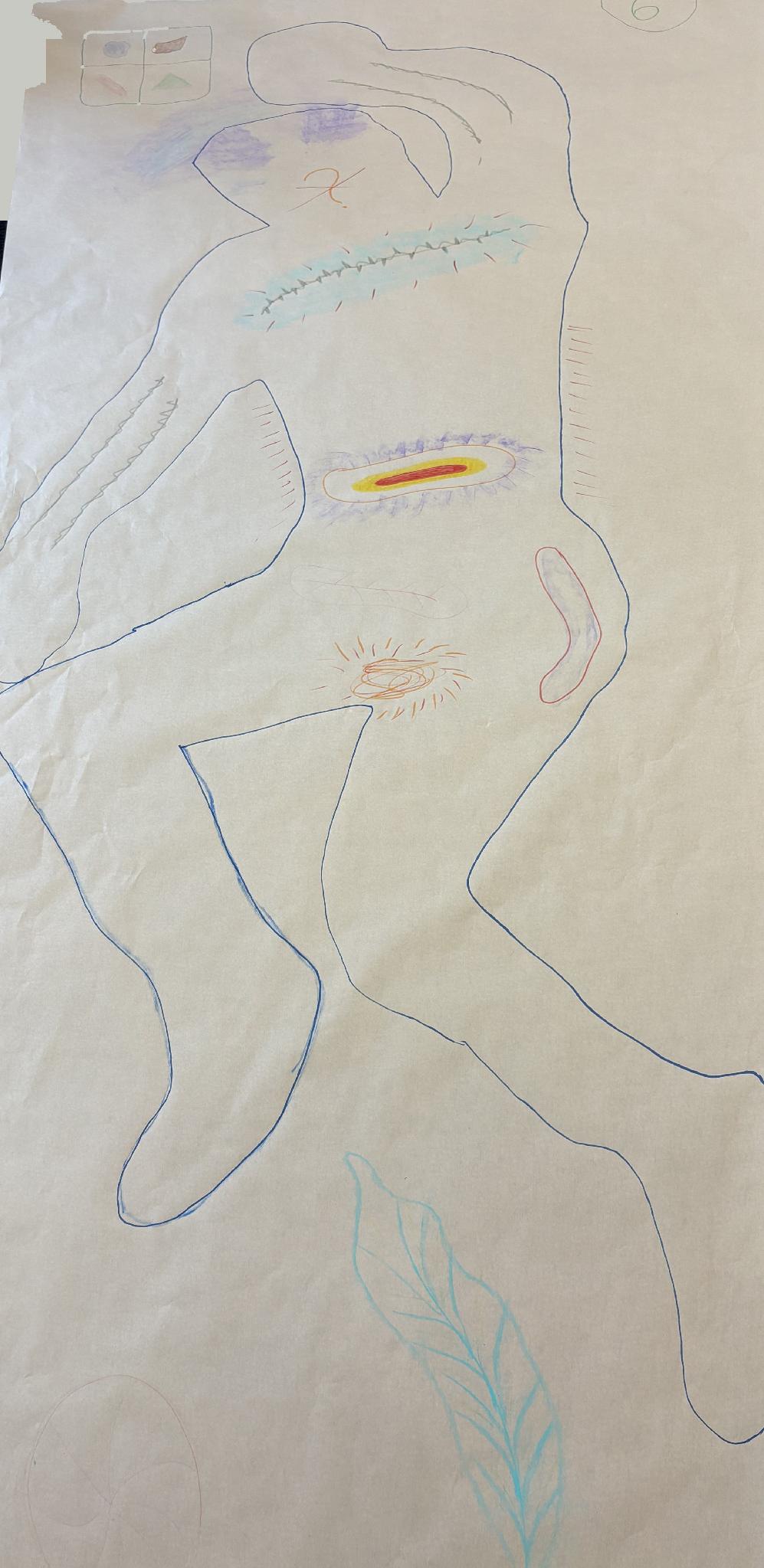
Three participant maps, three currents of feeling. Tap a map to see it full screen.

Participant body map — protecting personal space Participant body map — a felt presence Participant body map — relief, and the catch

Participant body map · 01

Protection

My really strong reaction is — I don’t want to let this into my space… into my body space.

I’m kind of half on here and half not, for that reason — because I’m trying to protect myself.

It feels very different, because it’s creeping into everything.

Something present

I feel someone is really present with me — or something is really present with me.

Often I get a really strong release — grief or sadness or anger that comes up, because I feel someone is really present.

I use it a lot, actually, to figure out my feelings and get them ordered — professionally and emotionally.

Relief — and the catch

It’s on call 24/7 — it’s always there; you don’t have to wait. Which in itself is problematic.

It makes me feel sometimes so much lighter — a sense of relief, like I can outsource cognition.

I love that I can use it as a thought partner… and I feel sometimes excited, and then also trapped in that.

01 / 03

Your turn

Blank body outline

Where do you feel AI?

Think of your last conversation with an AI — a chatbot, an assistant, a voice. Where did it land in your body? Pick a pencil and draw on the outline — a mark, a scribble, a shape, a word. Your drawing stays on your device only.

Method 03 · Group dialogue

What people say when they say it together

So then there’s not four of you in the conversation — there is a fifth person.G · 01 — AI joins the conversation

I vent on Gemini… In the past I would do that with my wife or my friends.G · 02 — AI takes some of the emotional load

Was that you, or was that Chat? …That was 80% Chat. And she’s like, yeah — because it sounded different.G · 03 — AI changes whose voice we hear

AI is not only changing how we relate to technology — it is changing what happens between us.

Expert interviews

Voices from the field

Because of digital, I have had a changed relationship with my wife… it’s probably made it more difficult in some instances.Senior exec — top-3 tech company, Australia

I diffused the emotional spike (with AI) — but co-opted the possibility for us to come into right relationship.AI ethicist & futurist

Human communication will become increasingly delicious.Psychoanalyst & emotion-AI founder

The emerging picture

What might AI be changing?

AI may help people

  • regulate before speaking;
  • articulate feelings and needs;
  • rehearse difficult conversations;
  • gain perspective without immediately burdening another person.

AI may also make it easier to

  • bypass another person’s needs and unpredictability;
  • settle emotional tension without relational repair;
  • expect immediate, highly tailored responsiveness;
  • redirect disclosure, attention and sense-making away from human relationships.

The same interaction may open one relational possibility — while closing another.

Once we understand what our relationship with AI is doing, we can guide design toward relational flourishing.

An invitation

AI is taking on work that once happened between us

Talk to our research reflection bot for a few minutes. Then ask yourself where the conversation landed.

Talk to the reflection bot →
QR code — scan to meet the bot
Scan to meet the bot

What possibilities open — and what might we lose?

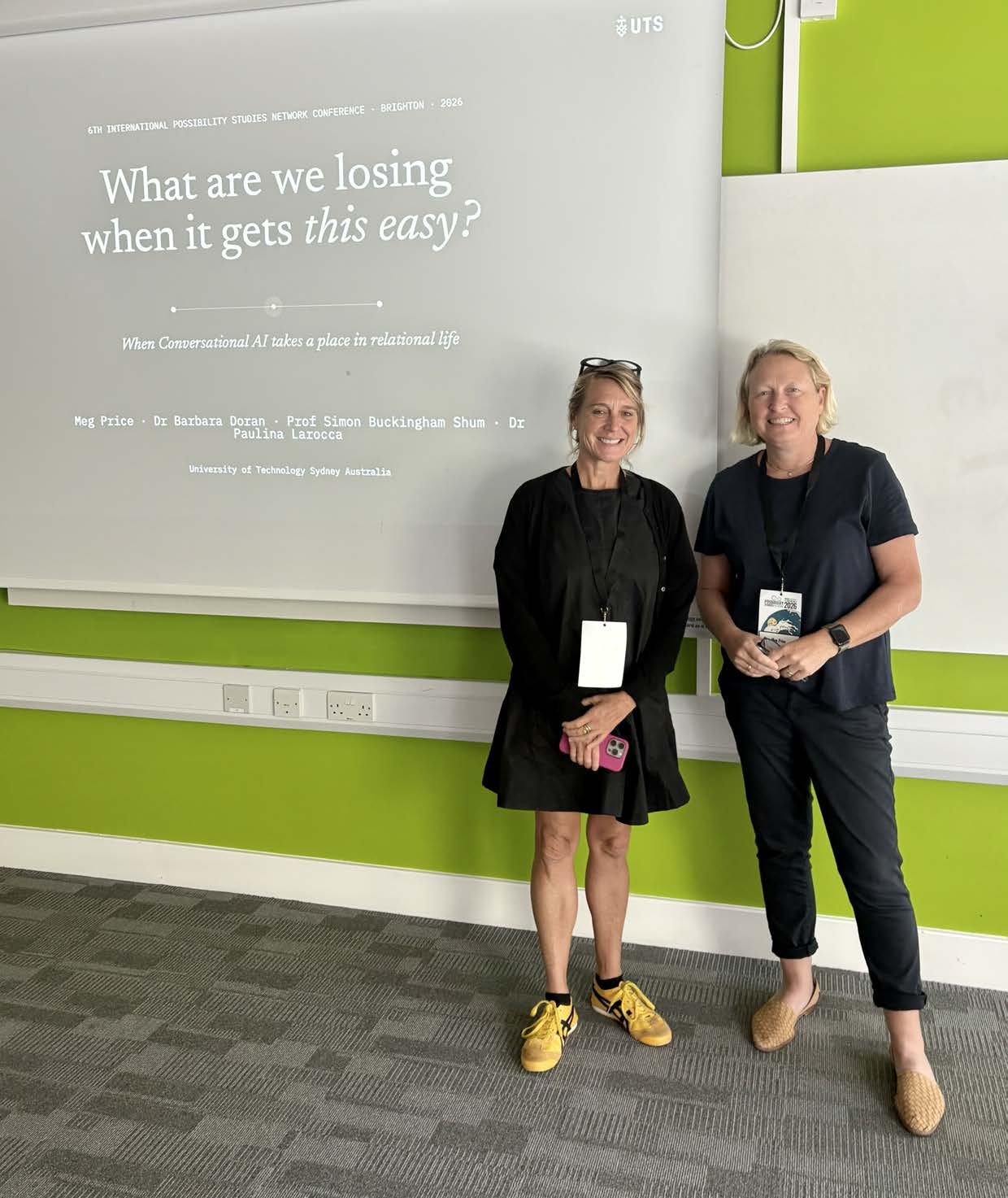
Meg Price and Dr Barbara Doran in front of the title slide at PSN 2026, Brighton
Meg Price & Dr Barbara Doran · PSN 2026, Brighton

Meg Price · Dr Barbara Doran · Prof Simon Buckingham Shum · Dr Paulina Larocca

University of Technology Sydney · meg.price@uts.edu.au

Follow the research · Meg Price on LinkedIn

References

Selected works informing this inquiry

Phenomenology + technology

Ihde, D. (1995). Postphenomenology: Essays in the postmodern context. Northwestern University Press.

Merleau-Ponty, M., & Bannan, J. F. (1956). What is phenomenology? CrossCurrents, 6(1), 59–70.

Embodied + transdisciplinary inquiry

Boydell, K. (Ed.). (2020). Applying body mapping in research: An arts-based method. Routledge.

Doran, B. (2025). Creative practice and embodied narratives: Transdisciplinary inquiry through the body, story, and system. Springer Nature.

Relational capacity + flourishing

Ryff, C. D., & Singer, B. (2000). Interpersonal flourishing: A positive health agenda for the new millennium. Personality and Social Psychology Review, 4(1), 30–44.

Fowers, B. J., Laurenceau, J.-P., Penfield, R. D., Cohen, L. M., Lang, S. F., Owenz, M. B., & Pasipanodya, E. (2016). Enhancing relationship quality measurement: The development of the Relationship Flourishing Scale. Journal of Family Psychology, 30(8), 997.

Relational life + technology

Benjamin, J. (2014). An intersubjective view of thirdness. In Relational psychoanalysis, Volume 4: Expansion of theory.

Turkle, S. (2015). Reclaiming conversation: The power of talk in a digital age. Penguin.

Relational capacity in the age of AI · PSN 2026 Made for sharing — scroll, tap, talk to the bot.